


The F1 universe is an infinite mass of glitz and glamour, and within this starry existence, worlds orbit and perpetuate the evolution of ultra high technology; galaxies and constellations thrive with generation after generation of beautiful beings. But… F1 sometimes reveals its black holes, from which mechanical monstrosities and freak Frankensteins lurk, rejects that shouldn’t have seen the light of day.

Take this 1978 McLaren M26 mid-wing experiment for instance. How on earth did James Hunt see where he was going whilst testing? Even without the add-on, the M26 wasn’t a particularly good car that season, especially with the far superior and dominant Lotus 79. Desperate times, desperate measures…

In 1982 Arrows had a stab at the mid-wing concept with their A5, and predictably, it didn’t perform very well, with no wins, no podiums and just 5 constructor points. Perhaps the driver didn’t know if he was coming or going?

This 1976 Ligier JS5 looks like it could actually create a black hole in the universe. Although it looks hideous, it did gain 20 points and claim 5th place in the Constructor’s Championship. After sucking in its competitors and spitting them out, it even managed pole at Monza.

In 1979 you wouldn’t have been deemed mad to think Ensign had employed dwarfs to drive their cars. After all, there’s a stepladder to gain access to the N179’s cockpit. It clearly doesn’t appear very aerodynamic, and the fact it failed to qualify on many occasions proved it was as bad as it looked.

Designer, Frank Constin must’ve been walking around in circles, pondering over aerodynamics, when out of nowhere he took inspiration from a granny’s boot slipper. Taking it further, he would then slap a giant breakfast tray to the front, making it a fast granny’s boot slipper. Joking aside, this March 711 took Ronnie Peterson to 2nd overall behind Jackie Stewart in the 1971 Driver’s Championship and also managed to tie with Ferrari for 3rd in the Constructor’s Championship.
Extra Limbs
At least Dr. Frankenstein botched a monster resembling what the final creation should’ve looked like. F1 designers haven’t always stuck to these basic guidelines, and as a result some beasts rolled out of the pit lane with the addition of extra parts.

In 1976 Tyrell unveiled what was considered one of the most radical designs in F1. Some love its looks whilst some think it’s ugly as sin. Aesthetics aside, Jody Scheckter and Patrick Depailler produced great results with this six-wheeled wonder, especially in Spain when they managed a 1 – 2 finish. However, due to Goodyear not developing the special tyres enough by the end of the season, and the added weight from the front suspension the following season, they eventually ended the six-wheeled project.

Considering Italy is famed for beautiful design, this Ferrari 312 T6 is simply ridiculous. Thankfully it didn’t conform to the permitted Grand Prix dimensions.

Williams and March also tried their hand with six wheels during the early eighties, but shortly after Williams looked to be making progress with their FW08 6 wheeler (pic above), the FIA banned the concept.

This looks like a something a schoolboy would doodle during a boring geography lesson. I happen to think it’s the coolest looking F1 car ever designed, and I wish that rear fan were a giant jet afterburner.
The Brabham BT46B “fan car” entered the 1978 F1 season at the Swedish GP, thirsty for Lotus 79 blood. The Lotus car was dominant due to its superior ground effect, but thanks to the BT46B’s fan, the Brabham car generated immense downforce by extracting air from beneath the car. Brabham claimed the fan was for extra cooling, but after Niki Lauda won the Swedish GP, it was declared illegal. This means is has a 100% winning record – excellent!

A Shift In Time
You’d have thought after all the ugly cars of previous decades, designers would’ve learnt a few lessons, like sticking a giant tray or step ladder onto the front of a car won’t make it any faster.
Throughout F1’s history, the majority of cars have been fantastic and beautiful creations, however, in 2012 several cars (including the pictured Ferrari) lined up on the grid sporting what looked like a “before” picture in a nose job advert.
I can only conclude that decades of ugly F1 cars prove this glitzy universe is infinite, and if the universe is infinite, it means more black holes…
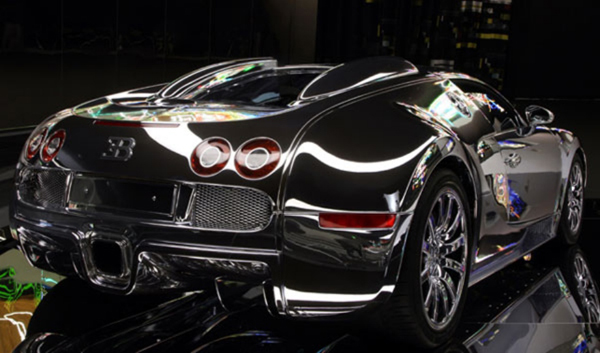
If being a Hollywood star isn’t glitz and glam enough for you, how about wrapping your supercar with a chrome-look finish? Now you can minus one from your entourage, the one responsible for holding your mirror. Not only can you use your car as a giant mirror offering up every angle possible, but it also stands out and makes a statement – whether this is good or bad, it’s entirely up to you.
The two biggest trends with Hollywood cars are actually polar opposites. At one extreme you have the “murdered out” matte black on black finish, whilst in total contrast at the other end of the scale you have the bright and gleaming chrome finish. Some even go as far as using a gold chrome finish… gold or gaudy? Take a look at who is doing what to their cars in Hollywood.
Kim & Kourtney Kardashian – Polished Audi R8
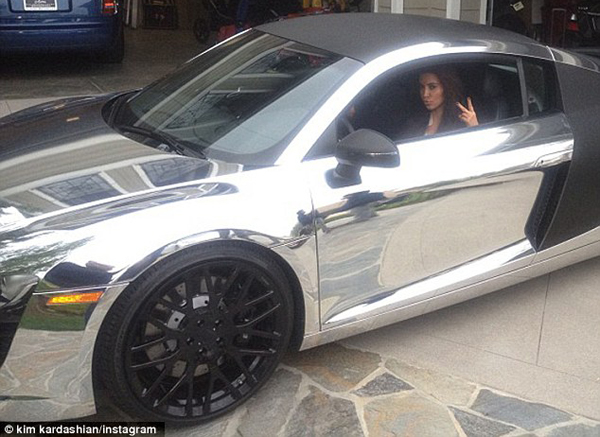
These Hollywood sisters and socialites probably spend more time looking into rather than driving this Audi R8. Nevertheless, out of most of the chromed examples, the Audi wears it better with the black side pods and wheels.
Justin Bieber – Polished Fisker Karma
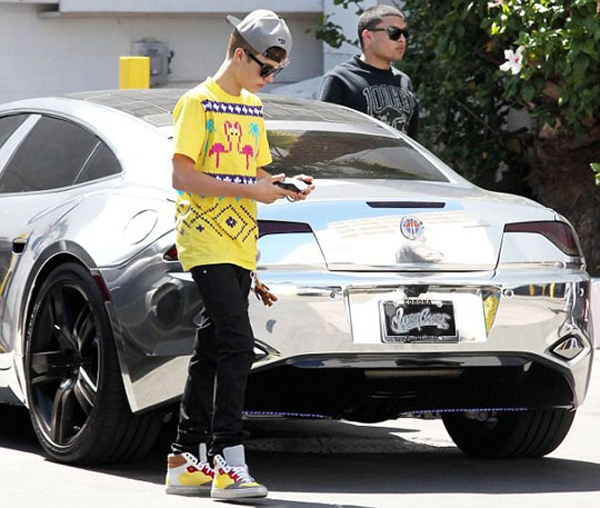
This kid has A LOT of decent cars. The depressing thing isn’t the fact he is only 19 and owns such fantastic rides; no, it’s what he does to them. How does a leopard print R8 sound? Or a “murdered out” black on black Cadillac CTS-V – okay this car just pulls the look off, but it looks more like the Batmobile than a classy town car. Add this chrome Fisker Karma to the bunch and you have a whole lot of beautiful cars turned ugly.
Flo Rida – Bugatti Veyron
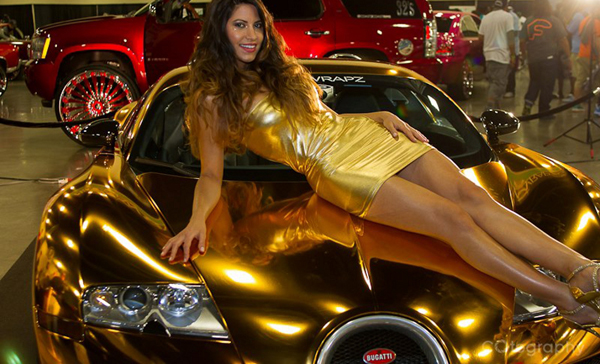
This American rapper loves Bugatti and has owned a few Veyrons, one of which he silver chromed, the other gold chromed. I guess this is subjective concerning if it’s a good or bad choice. Personally, I think it looks gaudy and hideously OTT.
Tyga – Audi R8
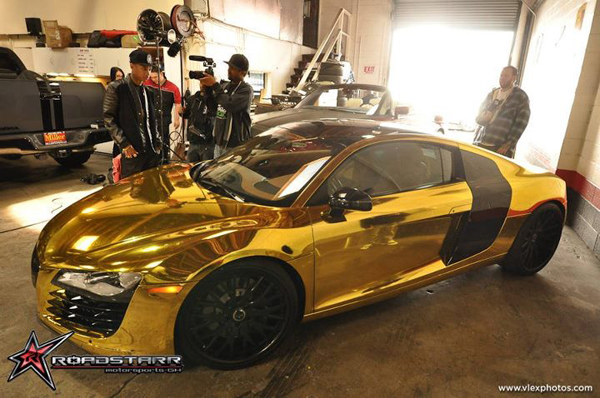
Tyga is another American rapper, a 23-year-old signed to Young Money Entertainment and Cash Money Records – notice the theme here? When you have this much cash to throw around, why not turn your Audi R8 into gold? Again, a little OTT but at least the black side pods give it a little style.
Ray J – Rolls Royce Phantom
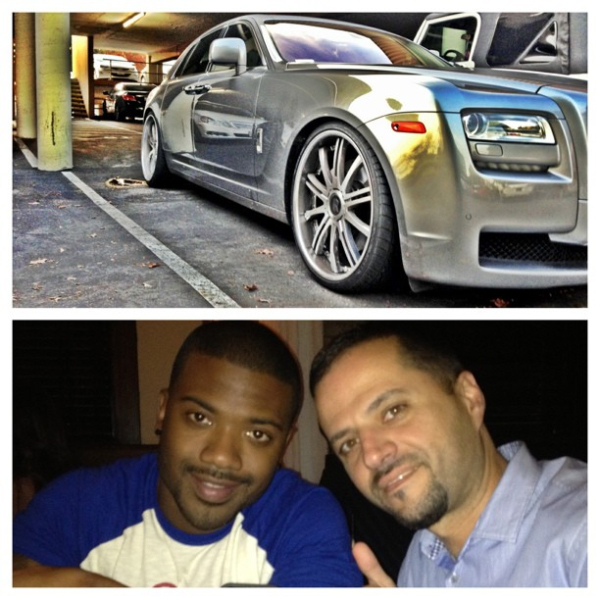
Being an American singer, songwriter, record producer and actor, Ray J has his finger in many pies. Many pies mean many pots of cash.
Now, I’ve written about customising a Rolls Royce before, and no matter where you stand on the subject, customising a Roller is like dressing the queen in bondage gear. A Rolls Royce is an elegant vehicle made from the planet’s finest materials (they only use bull’s skin because a cow’s skin has stretch marks from pregnancy!), a heritage that evokes words such as class, refined, elegance, opulence and sophistication. Wrapping a RR in chrome is a big no no and that’s that.
Theo Paphitis – Maybach 62 S
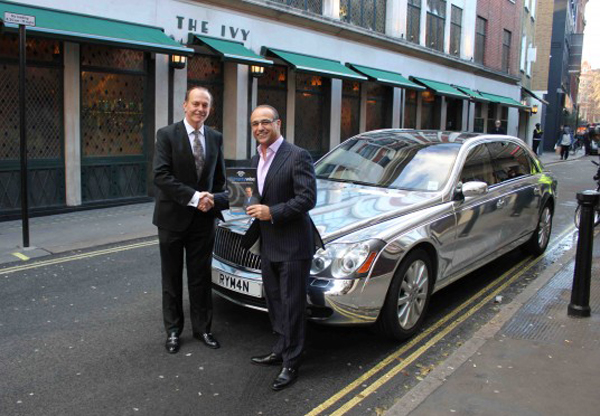
Theo Paphitis is perhaps best known for his role as a dragon on the BBC’s “Dragon’s Den”, a program aimed at future entrepreneurs. Apart from owning various stores and businesses, Theo was a former chairman of Millwall Football Club.
Like Ray J’s Rolls Royce, the Maybach is supposed to be a luxurious and classy vehicle capable of transporting people from A – B in maximum comfort. The Maybach pictured here looks fractionally better than the RR, but to me it now looks like something drunken girls on a Hen night might fall out of outside a nightclub.
So as you ca see, you either love the chrome look or hate it – I personally don’t like it an can’t think of any car that would benefit from it.

Back in November 2011, Daimler’s CEO Dieter Zetsche took a drastic decision and announced that the Maybach brand will be shut down starting with 2013. This decision was harsh, but necessary for Daimler, since Maybach didn’t manage to rise up to its rivals’ level and was a financial black hole for the German giant.
Looking at the numbers, things are catastrophic: in 2010, Maybach sold only 157 units and less than 50 units in 2011. These numbers are pretty far from what Daimler had in mind in 1997 when they decided to revive the brand created by Wilhelm Maybach.

Some might say this was caused, in part, by the financial crisis, but this doesn’t really stick if we look at how Maybach’s competitors did in the same time frame: for example, Rolls-Royce sold 2,711 cars in 2010, a record for the British brand owned by BMW, while Bentley sold 4,763 units. But Maybach couldn’t find its place in the ultra-luxurious automobiles world. On a market where the number of customers with endless possibilities constantly grew, the German brand failed to impress.
But before we see why an ambitious project like Maybach backed by a giant like Daimler turned into a failure, let’s take a look back and see Maybach’s heritage and how this company evolved throughout history.
Maybach – The History
Despite its sad ending, Daimler’s former luxury brand has an important history behind it. It was founded in 1909 by Wilhelm Maybach and his son, Karl. Maybach has always been close to Gottlieb Daimler and he was always considered to be one of the best designers for engines and systems for the first automobiles.

He was born on February 9, 1846, in Heilbronn, a city near Stuttgart in the Baden-Wurttemberg state, Germany. He had four brothers and lost both his parents when he was just 13 (his mother died when he was ten, his father three years later). With some assistance from his relative, Maybach was accepted into the Reutlinger Bruderhaus, a philanthropic institution in Reutlingen. This part of his life is extremely important for two reasons. First one is that the institution’s founder and director, Gustav Werner, noticed young Wilhelm’s technical skills and encouraged him to follow his passion by sending him to the school’s engineering workshop. Second is that here is where Wilhelm met Gottlieb Daimler, who was the workshop’s manager. Impressed by Maybach’s abilities, Daimler took him as his assistant, in 1865, starting their life-long collaboration, one of the most famous and productive in the automobile industry.

For Daimler, Maybach remained one of his closest friends and associates until his death, in 1900, having worked together in countless projects. In September 1869, they worked together in Karlshrue at Maschinenbay-Gesellschaft, a locomotive and railway wagon manufacturer. Later Daimler moved to Deutz, an engine manufacturer based in Koln, Germany, where he took Daimler with his as his chief designer. This was a time when Maybach started working on light, high-revs, internal combustion engines which were used for ground transport, ships or airplanes. Also, 1879 was the year his first son, Karl, was born, who will later play an important role in continuing his father’s work.
Following some strong disagreements with the management (mainly with the owner, Nikolaus Otto, the inventor of the four-strike engine), Daimler left Deutz Gasmotoren Fabrik in 1882 and set up an independent workshop on the Taubenheimstrasse in Stuttgart. Soon, in Octomber 1882, Maybach followed and continued his work on light engines he started while at Deutz.
In 1883, Maybach built the first horizontal engine, followed by what it is known today as the “Grandfather Clock” engine, widely considered the predecessor of the modern internal combustion engine. The engine was lighter than conventional ones, it had only one cylinder, a revolutionary hot tube ignition and was specially designed to be installed on small vehicles. In November 1885, the engine was first installed on a wooden bicycle (thus the world’s first motorcycle was born) and in March 1886 it was used on a stagecoach. The motorcycle was driven by Maybach for about 2 miles at a top speed of 7.5 mph, while the motorized stagecoach reached a top speed of 10 mph. Funny thing is that people living around the workshop didn’t know what exactly happened around there and, alarmed by all the metal sounds, used to call the police all the time, thinking the two were involved in counterfeiting.

Even though their inventions were admired by everyone, Daimler wasn’t satisfied with just building engines for stagecoaches, so Maybach started working on an automobile with steel wheels. The final product was unveiled in 1889 in Paris and it was the first time a four speed transmission was used. This engine and Maybach are considered extremely important in the development of France’s early automobile industry.
Daimler and Maybach together founded the Daimler Motoren Gesellschaft company in 1890 but troubled times followed. Maybach left a year later after some disagreements with a few members of the board, founding his independent workshop. Daimler also left, in 1893, but both came back in 1894 at the request of Frederick Simms, a British businessman who got involved with Daimler. Still, during these years, Maybach’s contribution to the automobile industry was huge, with inventions such as a new tubular radiator with fan and the honeycomb radiator.
Following Daimler’s death in 1900, Maybach kept building engines, but also started building cars. His first one was commissioned by a wealthy Austrian (who was a successful dealer and racing driver) and its engine was named Daimler-Mercedes, in honor of Daimler and of Mercedes, the dealer’s ten year old daughter. The car is now known as the Mercedes 35 hp (the first time the Mercedes name was used) and was extremely successful in racing, which also led to an important commercial success.
But Maybach again went into conflict with DMG’s management and left the company in 1907. Two years later, he founded the Luftfahrzeug Motoren GmbH, with his son Karl as manager. Back then, Maybach’s main business partner was Count Ferdinand von Zeppelin and the company mainly built airship engines. In 1912, it was renamed to Maybach Motorenbau GmbH and business was very good since World War I started (they sold more than 2,000 aircraft engines in that period).
However, after the war ended, demand for aircraft engines dropped and Maybach started working more on building his own automobiles. What’s interesting is that neither Maybach nor his son ever owned one of the cars they built. Actually, Maybach never owned a car in his life. Which life ended on December 29, 1929, at the age of 83.
The first car to come out of the Maybach workshop was the Maybach W1, built by Maybach’s son, Karl, as a test unit, based on a BMW chassis. This happened in 1919.
Maybach W3
The first fully functional automobile in the brand’s history will be the Maybach W3, launched in 1921 at the Berlin Motor Show, starting the glory days for Maybach. Built between 1921 and 1928, the W3 was powered by a six cylinder engine with a 5.7-liter displacement that produced 70 hp (51.5 kW). The rear-wheel drive car had four doors and despite its weight of more than two tons, it was able to reach 68 mph (almost 110 km/h) at a fuel consumption of 18-20 liters per 100 km.

During the seven year production run, 305 units were built, with two versions available, open and closed body. As you can see, there’s a W2 missing in between. This one has an interesting story, because in the beginning, the W2 was a line of 5.2-liter engines developed for Dutch car manufacturer Spyker. However, not all were sold and Karl Maybach decided to use these engines for Maybach cars, to save some of the costs.
Maybach W5
The Maybach W5 was actually a more powerful version of the W3. The engine displacement was increased from 5.7 to 7.0 liters for an impressive power boost of 50 hp. That meant that the new 120 hp (89 kW) W5 was able to reach a higher top speed, 80 mph. Other than that, it wasn’t too different from the W3. It was also available with an open or a closed body and was built between 1926 and 1928.

Towards the end of the production run, in 1928, an “SG” version was launched (which stands for “speed gear”) that had an improved overdrive transmission installed. This type of transmission allowed the car to go faster than 80 mph and the special gear was activated through a lever, without any clutch action involved.
The total production run was of around 250 units and one of these, a Maybach W5 SG Pullman limousine from 1926 is the oldest surviving Maybach. The car belonged to Dr. Vogler, the personal physician of famous tenor Enrico Caruso, has been restored in the ‘80s and is now on display at the Auto & Technik Museum in Sinsheim, Germany.
The Maybach 12
The Maybach 12’s production run was extremely short, from 1929 to mid-1930, with 200 units built in this period. The twelve cylinder model replaced the Maybach W5 SG and it was considered one of the best cars of its times. The 7.0-liter V12 was producing 150 hp and coupled with an advanced three speed transmission with overdrive was able to take the car up to a top speed of more than 90 mph.

Despite the car’s large size, Karl Maybach paid a lot of attention to reducing the engine’s weight as much as possible, so the car’s final power to weight ratio was extremely good for that age. Actually, it would take a while before any other cars would achieve anything similar. Also, many experts claim that this engine is the predecessor of a famous modern engine, the 6.0-liter V12 used by recent AMG models.
As for the design, the Maybach 12 was getting pretty similar to cars from the newly formed Mercedes-Benz brand and that was because Karl started working for them. However, this model only prepared the world for what was about to come, the…
Maybach DS7/DS8 “Zeppelin”
Launched in 1929, the Maybach “Zeppelin” was the small car manufacturer’s flagship. The first generation was the DS7, whose name stood for “Doppel Sechs” (Double Six) reffering to the V12 engine. The 7.0-liter unit delivered 150 hp, quite similar to the one on the Maybach 12, making many experts call the Zeppelin just a re-branded version. But there was more to it. The DS7 featured a four speed sequential transmission, was able to go as fast as 93 mph and used enlarged four bolt main bearing caps, plus camshaft gears made from new material called Novotex which significantly reduced noise.

The “Zeppelin”, or the DS7 by its official name, was an impressive automobile in those days. Besides the incredible powerful engine, it was also huge. At a gross weight of around 6,600 lbs it required for drivers in Germany to have a goods vehicle license to be able to drive it.
A year after the DS7 debuted, a new version was introduced, the DS8. As you can probably guess, engine displacement was increased to 8.0-liters, providing a significant power boost of 50 hp. With the total power output at 200 hp mated to the five speed manual transmission, the DS8 became one of the most powerful cars of the time. Also available as an open top and closed body, the lighter versions were able to go as fast as 106 mph.
The Maybach DS7 was in production until 1931, while the last DS8 was built in 1939.
Maybach W6
Creating such technical marvels was extremely beneficial to Maybach’s image, but it soon became an issue, because such advanced cars were also very expensive. And since Europe wasn’t going through its brightest economic period, slow sales forced Maybach to look for alternatives to sell more cars.

And this is how he came up with the idea for the Maybach W6. In order to make it more price attractive, he used the existing production facilities where the W5 was built, used the same SG engines and put them on the newly developed DS “Zeppelin” chassis. However, even though the car was still able to go 75-80 mph, the new model’s dynamics were heavily influenced by the large weight. What Maybach hoped to achieve with the W6 was to create the image of a more affordable “Zeppelin”, which was almost everyone’s dream car back then.
But the W6 wasn’t a success and sales failed to rise to Maybach’s expectations. In 1934, the W6 DSG was introduced, which featured a newly designed twin overdrive transmission system that was supposed to improve the way the car handled. But sales didn’t improve significantly and the W6 production was ended in 1936.
Maybach DSH
Introduced in 1930, the Maybach DSH wanted to cash in some of the huge attention Maybach was getting after launching the “Zeppelin”. The thinking behind its name is quite strange: it stands for “Double Six Half” (it had six cylinders) and wanted to show the car’s mutual DNA with its larger brother. The DSH was powered by a newly developed 5.2-liter engine and was another attempt to create a more affordable car. Total power output was 130 hp and using the four speed sequential transmission it was able to reach a top speed of 87 mph (140 km/h).

The convertible was very similar to the Mercedes-Benz Nurburg Cabriolet, but for some reason, the Maybachs were more popular. Not too popular though, because the total number of units sold (both closed body and open top) was 100, between 1930 and 1937.
Maybach SW35, 38, 42
It seems that creating a truly affordable car that would sell has always been a challenge for Karl Maybach. After failing to achieve commercial success with the W6 and the DSH, Maybach launched the SW 35 (Schwingachs Wagen) in 1935.
With development started from scratch, the new SW 35 was unveiled for the first time at the 1935 Berlin Motor Show and it impressed everyone with its outstanding coachwork and level of luxury. The 3.5-liter six cylinder engine (hence the name) produced 140 hp at 4,500 rpm and was able to take the car to a top speed of 85-100 mph, depending on the body type.

An upgraded version was launched in 1936, the Maybach SW38, whose engine displacement was increased to 3.8-liters. Despite that, power output was the same, 140 hp.
The final version of the SW was the SW 42, produced between 1939 and 1941. Despite also having its engine displacement increased (to 4.2-liters), the car offered the same power output as his predecessors, 140 hp. What the SW 42 did bring new was an incredible level of luxury. Extremely expensive and refined materials were used and the car was available in a lot of body versions (especially the long wheelbase model). 850 units were sold, so it was really successful compared to other models.
Due to the World War II getting more serious, car production was ceased in 1941. Since the first Maybach was built, 1,750 cars were produced in sold in the Maybach factory. After the war ends, Karl Maybach starts rebuilding the factory in Friedrichshafen. Six years later, during which he kept designing engine, he starts working on a new Maybach car, but is forced to abandon the project due to lack of funds. One year later he retires from the company and dies on February 6, 1960, leaving behind an amazing motor heritage.
The same year, Maybach Motorenbau GmbH is bought by Daimler and used to create special editions of the Mercedes-Benz W108 and W116.
In the second half of the ‘90s, Daimler seriously started thinking about building a competitor for ultra-luxury car manufacturers such as Rolls-Royce or Bentley, which were owned by two of its main rivals, BMW and Volkswagen. And all eyes turned to Maybach. The 1997 Tokyo Motor Show marked the debut of a new luxury concept car, which will go into production as the Maybach 57 and the Maybach 62 (the numbers referred to the models’ length). The first unit was sold in 2002 and several version were available during the production run: long wheelbase (57S and 62S), Zeppelin and Landaulet. The special edition 62 Landaulet is the most expensive Maybach ever sold, with a list price of more than $1.2 million.
Maybachs were also modified by Mercedes’ traditional tuning company, Brabus. The Maybach Brabus was unveiled in 2004 and it was powered by a twin-turbo 6.3-liter V12 that produced 640 hp and 757 lb-ft of torque. According to official specs, it was able to sprint from 0 to 62 mph in 4.9 seconds and reach an electronically limited top speed of 190 mph. However, the high-performance Maybach never went into production.
What went wrong at Maybach?
Why didn’t it succeed in the ultra-luxury market? First of all, Maybach was coming with a car built on an older S Class’ platform. People did not like that and were not willing to pay $400,000 for a rebadged S Class with several luxury features. Another reason was that the brand never got the attention it deserved. During its production run of 10 years, no new technology has been introduced on the Maybach. You will see it first on the S Class, or the A Class, or any other class, but not Maybach. And that’s why the public probably never saw Maybach as Daimler’s true flagship, like it was supposed to be.

All these, combined with Daimler’s failed attempt to start a partnership with Aston Martin to build a new Maybach generation led to Dieter Zetsche’s sad announcement. And on December 17, 2002, the last Maybach was produced at the Sindelfingen plant, after only 3,000 units were built in total, a lot less than what Daimler expected.
So what will happen next? Sadly, it looks like this is the end of Maybach and unless some miracle happens in the future, we’ll never see a “Maybach” badged car ever hitting the streets again, because Daimler announced the name will not be used anymore. It’s sad to see a brand whose name is connected to some people that important to the car industry simply go away, but unfortunately that’s how life and business are. As for the ultra-luxury market segment, Daimler announced that the upcoming S Class will take over this task from Maybach. To do that, the new Mercedes flagship is announced as being more luxurious than ever and will be offered in three wheelbase versions, including an S600 Pullman.
Anyone who knows a car has four wheels and a steering wheel will also know a turbocharger or supercharger will make it go faster; nothing gives a car a kick in the pants quite like these two modifications.

Superchargers and turbochargers have been around since the 30’s, but they weren’t as refined as the components installed into today’s machines. The way in which the supercharger works allowed for better performance than the initial turbochargers, which eventually faded out due to the invention of fuel injection. However, by the 80’s the turbo made a comeback, and has since been constantly refined to offer the amazing results we see today.

In this modern and environmentally aware society, car manufacturers are able to reduce engine displacement by installing a turbocharger or supercharger for extra power – cars with engines as small as 1.0L can now offer an added kick from turbos whilst maintaining good reliability (see pic below of Ford’s 1.0L eco boost unit). At the top end of the market, technology has offered performance cars two or more turbochargers (twin-turbo) or a supercharger for decades now, but advancements allow for greater reliability and the ability to counter “turbo lag”, something superchargers don’t suffer – this I’ll explain later on. Ultimately, smaller engine displacement means less fuel consumption and better CO2 emissions.
How Superchargers and Turbochargers Both Work

Both components work on the principle of forcing more air and fuel into the engine for a bigger explosion. Without going off topic and going into too much detail, I’ll describe the engine as essentially a big air pump working at atmospheric pressure, with the pistons creating negative pressure when they go down, sucking in air through the intake valve into the cylinder. The air is then combined with fuel and compressed when the piston moves up inside the cylinder. Once compressed it is ignited by the spark plug, and the subsequent explosion forces the piston back down again, where the gases leave the cylinder via the exhaust valve… and so the cycle continues.
So in the most basic form, a supercharger and turbocharger forces air into a standard engine running at atmospheric pressure.

How Turbochargers Work
You’ll find the turbocharger bolted to the exhaust manifold, where the exhaust dispelled from the cylinders spins a turbine. From this turbine, a shaft connects it to the compressor wheel, which is positioned between the air-filter and the intake manifold.
As the waste exhaust gases pass through the turbine blades, they start to spin, and the more exhaust passing these blades, the faster they spin. The spinning turbine blades turn the compressor wheel, and as the compressor wheel spins, it pumps air into the engine’s cylinders.
Turbos have to spin at speeds of up to 150,000 rpm, so most modern turbochargers use a fluid bearing instead of standard bearings. Using this type of bearing allows the shaft to be supported by a layer of oil, which cools the shaft and turbo components, plus it reduces friction.

The downside to turbochargers is they don’t provide an immediate response when you hit the accelerator. This is because it takes a moment (depending on the engine revs and how much exhaust is produced) for the turbine blades to get up to speed before it creates the right amount of pressure. This is called “turbo lag”, a feeling of slow acceleration followed by an almighty boost.
A way to eliminate turbo lag is to operate the car in the right gear at the correct speed, ensuring the turbo is operating in the right rev window – the higher the revs, the more exhaust passes through the turbine. Another way is to reduce the inertia of any spinning components by reducing their weight using ceramic blades. This allows the turbine and compressor to operate faster, producing boost earlier.
As previously mentioned, some engines use two turbochargers of different sizes to counter lag. A smaller one is used first because it gets up to speed faster, whilst a larger turbo kicks in at higher engine speeds to provide extra boost power.
Most turbochargers also use an intercooler to maintain the air supply to the engine is cool, helping performance – cool air is denser and contains more air molecules than hot air. The intercooler is like radiator, with air passing over it from the outside, as well as air passing through sealed passageways within.
The upside to turbochargers is the fact they are more tuneable as they come in different sizes, and boost (psi) can be controlled to suit different needs i.e. racing or street driving.

How Superchargers Work
Superchargers work on the same principle as the turbocharger, although they create air pressure in a different way. Whilst turbochargers use waste exhaust to create air pressure, a supercharger uses the crankshaft. The crankshaft spins, and when the car is in gear and in motion, the gear drive, attached to a pulley via shaft and an accessory belt, operates the compressor pump.
Simply put: This car moves in gear, the gear drive spins the compressor, more air is forced into the engine. Some rotors in the compressor come in various designs, but its job is to ultimately suck in air, pressurise it and discharge it into the intake manifold.

Like the turbocharger, supercharger’s moving components create heat under exertion, so intercoolers are also needed.
As the supercharger works from the instant acceleration of the drive gear and doesn’t rely on the build up of pressure from exhaust gases, it doesn’t suffer “turbo lag”, one the supercharger’s upsides.
Another upside is a supercharger is far less complex than a turbocharger and requires less modification of the exhaust system; a supercharger is usually simply bolted to the top of the engine, thus making it less expensive to install and generally cheaper to maintain.
The downside of a supercharger is the fact it uses 20% of the engine’s power using its crankshaft to power the compressor. Although it manages to add an additional 46% back, it isn’t as versatile as the turbocharger at producing massive figures.
So if you are thinking about turbocharging or supercharging a vehicle, you may want to consider just buying a car that has them factory fitted, as it can be expensive and they have to fitted and tuned in perfect balance with your engine. Then you have the engine’s ECU (Engine Control Unit) and MAF sensor (Mass Air Flow) to consider; a slight unbalance could really affect your engine’s performance.
 Gargling Gas